How to Compare UK Petrol Prices and Estimate a Fill-Up

Compare nearby pump prices before setting off, then use your vehicle’s tank size to estimate the cost of a fill-up. RAC Fuel Watch publishes UK average petrol and diesel prices, but those averages are a national guide, not a quote for a particular forecourt. Check the RAC page’s displayed figures and update date when you use them, and confirm local prices before you travel.
Check current prices near your route
Start with the RAC Fuel Watch page for its latest UK average prices for petrol and diesel and its commentary on price movements. Note the date shown beside the figures: fuel prices can change, so an undated number may no longer be useful.
Treat the national average as context. It can help you see the broad level of prices, but it does not tell you what a station near home, work or your route is charging. For a local comparison, check current prices through a fuel-price app or website, where available, and confirm the station and fuel type before you go.
Read also: How to Compare UK Petrol and Diesel Prices Before a Drive
Compare like with like: regular unleaded with regular unleaded, or diesel with diesel. Check that the station is open and that the listed price is current. If a price matters to your decision, verify it with the forecourt when practical; listings can lag a price change.
Why petrol and diesel prices differ between stations
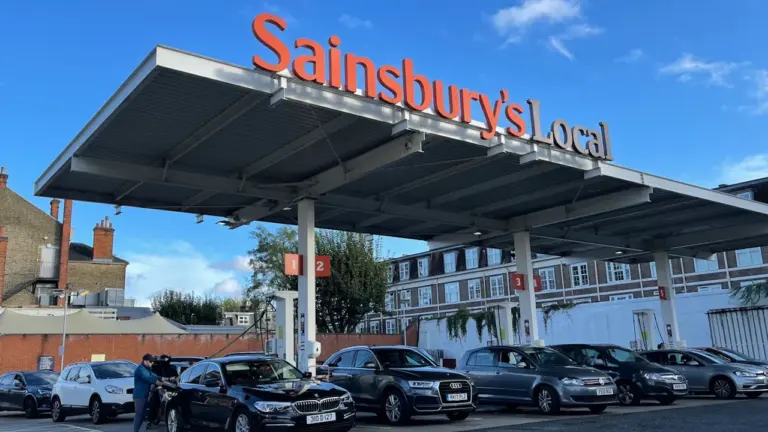
Pump prices can vary by location and forecourt. Nearby stations may have different costs, competition and pricing decisions. A motorway service station, a supermarket forecourt and an independent site may therefore show different prices, even in the same area.
Prices also move over time. RAC Fuel Watch provides commentary on fuel-price movements alongside its averages, which can help explain broader changes. Local pump prices do not necessarily change at the same time or by the same amount, so use current local information when choosing where to refuel.
The fuel grade matters too. If your vehicle requires a particular grade, compare only stations offering it. A lower price for a fuel your vehicle cannot use is not a saving.
Estimate the cost of filling your tank
Use this calculation:
Litres needed × price per litre in pence ÷ 100 = cost in pounds

For example, if you need 40 litres and the pump price is 150p per litre, the estimate is 40 × 150 ÷ 100 = £60. This is a checked arithmetic example, not a statement of today’s UK price.
To estimate a full tank, multiply the tank capacity by the price per litre. A 50-litre tank at 150p per litre would cost 50 × 150 ÷ 100 = £75 from empty. In practice, most drivers refuel before the tank is completely empty, so the amount paid depends on how many litres the car needs.
Your vehicle handbook or manufacturer information can help you find the tank capacity. The dashboard’s fuel gauge is only an approximate guide to how much remains, so treat a top-up estimate as an estimate rather than an exact bill.
Compare the saving with the detour
A cheaper forecourt may be worth considering if it is already on your route. Before making a separate trip, check the extra distance and driving involved. The price difference per litre may look small, but the saving depends on how much fuel you buy.
For instance, a 5p-per-litre difference saves £2 on a 40-litre purchase: 40 × 5 ÷ 100 = £2. If reaching the cheaper station adds a substantial detour, that saving may be reduced or erased by the fuel used on the extra journey. Traffic, time and convenience also matter.
Compare the total trip, not just the pump price. Check nearby forecourts first, especially those along a journey you already plan to make. If the likely saving is modest or uncertain, filling up at a convenient station can be the more sensible choice.
A quick refuelling check
- Check the RAC Fuel Watch figures and the date displayed on the page for national context.
- Compare current local prices for the correct fuel type and grade.
- Estimate your likely purchase using litres needed and the price per litre.
- Check whether a cheaper station is on your route before adding a detour.
The next useful check is the current price at a nearby forecourt for your vehicle’s fuel type; the RAC average can help put that local quote in context.
Source: RAC
Context & actions About this article
Source check Price-check method
RAC Fuel Watch provides UK average prices and movement commentary; local forecourt prices can differ and should be checked separately.
- Read the latest displayed petrol and diesel figures and their update date on RAC Fuel Watc...
- Compare the same fuel type and grade at nearby stations.
- Confirm a listed local price before making a special trip.
- Calculate the likely saving against the extra distance.
- Source
- RAC Fuel Watch
- Scope
- United Kingdom
- Updated
- 2026-10-24 09:28
Source check
Report a trust issue
Send a clear signal to community moderation if the source, facts or context need review.


Comments